
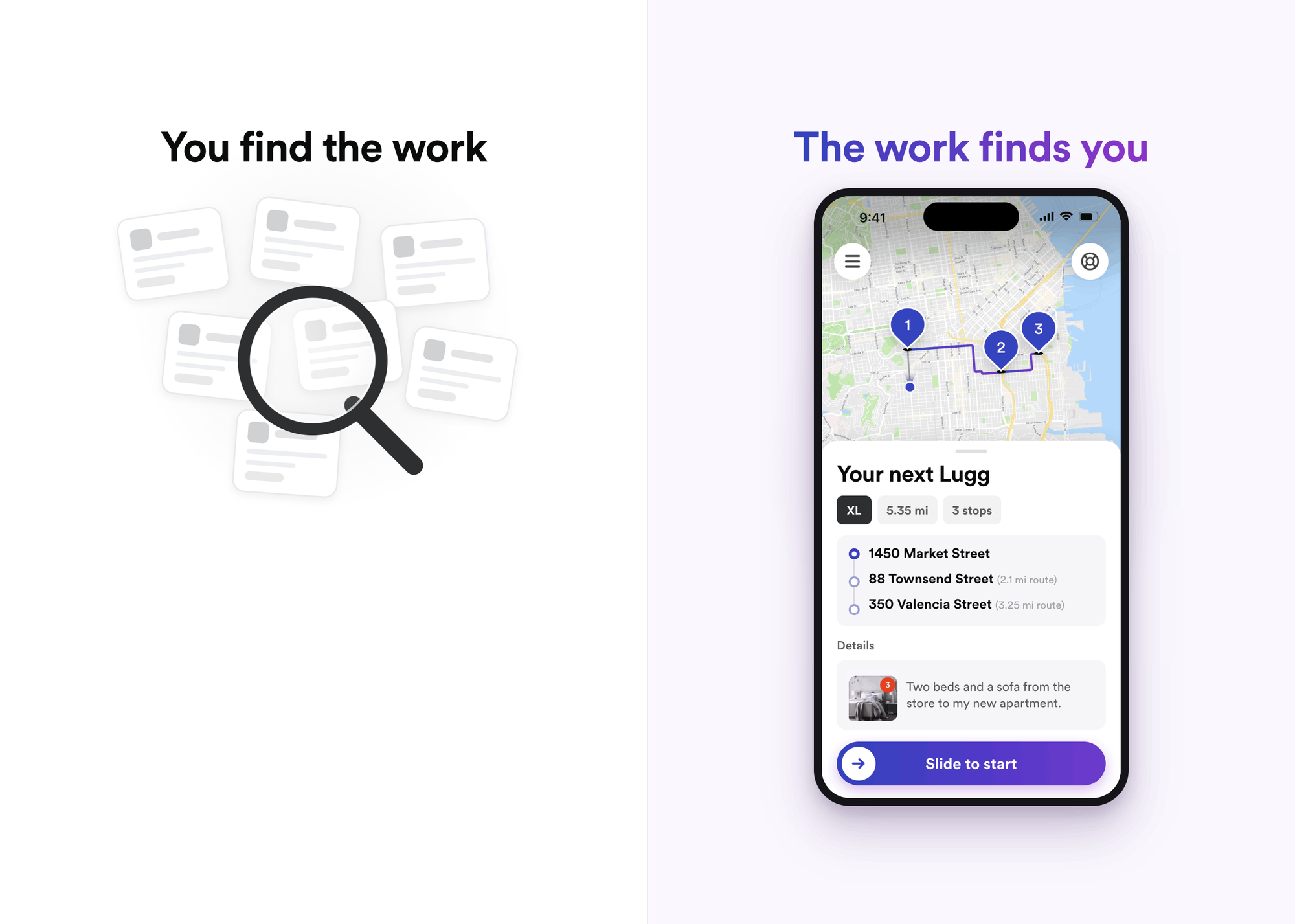
If you're deciding between driving for GoShare and driving for Lugg, the biggest difference isn't the hourly rate — it's how you get the work. On GoShare, you find the jobs yourself: you watch the app for available loads, accept the ones you want, and deal with the customer directly. On Lugg, you claim a slot ahead of time and the platform dispatches moves to you during that window. Both pay you as a 1099 independent contractor to move furniture and freight with your own pickup, cargo van, or box truck. But that one structural difference shapes everything else — when you work, how steady it is, and how fast you get paid. GoShare advertises rates from $45 up to $168 an hour, though ZipRecruiter pegs the real 2026 average for a GoShare driver closer to $19 an hour. Here's an honest look at how the two compare.
GoShare vs. Lugg for drivers, at a glance
| For drivers | GoShare | Lugg |
|---|---|---|
| How you get work | Marketplace — watch the app, accept loads | Claim a slot; Lugg dispatches the moves to you |
| Customer relationship | You manage it | Lugg handles the booking and support |
| Pay timing | Weekly direct deposit (~4 business days) | Same-day pay |
| How pay is built | Per-job quote, varies by vehicle and distance | % of the fare: base, per-minute labor, mileage |
| Vehicles | Pickup, cargo van, box truck (2004+); car for small courier jobs | Pickup, cargo van, sprinter, box truck (2001+) |
| Cost to start | $49 non-refundable background-check fee | Free sign-up; background check after |
| Equipment | You bring your own | You bring your own |
| Tips | Kept in full | Paid directly to you |
How much do GoShare drivers actually make?
GoShare drivers earn an average of about $19 an hour, according to ZipRecruiter's 2026 salary data — well under the $45-to-$168 range GoShare advertises. The gap is worth understanding before you sign up.
Those top numbers assume the best case: a box truck or cargo van working larger commercial loads in a busy metro. A pickup driver in a lower-density market is at the bottom end, and the headline rate doesn't count the unpaid time spent driving to a pickup, the $49 fee to get started, or the damage liability some drivers report running up to $5,000. Box truck and cargo van drivers consistently report higher earnings than pickup drivers, because they qualify for the bigger jobs. Tips are yours to keep on top of the fare.
So the honest version: GoShare can pay well if you've got the right vehicle in the right market and you're willing to chase the high-value loads. For a lot of pickup drivers, the real number lands closer to that $19 average.
What do you need to drive for GoShare?
To drive for GoShare you need a qualifying vehicle, valid insurance, a smartphone, and a clean background check — plus a $49 non-refundable fee to get started. The vehicle has to be a pickup truck, cargo van, or box truck that's model year 2004 or newer (cars are accepted only for small courier deliveries).
The background check runs through Checkr and looks for a clean driving record: no DUIs or reckless-driving violations in the past three to seven years, and no more than three minor violations in the last three. Once you're approved, some drivers are active in as little as three days. The $49 charge is the part new drivers tend to miss — it's upfront and you don't get it back, whether or not the jobs in your area end up being worth it.
How do GoShare drivers get jobs?
On GoShare, you find the work yourself. It's a marketplace: you open the app, see the available loads — GoShare calls them "hot shot loads" — and accept the ones that fit your vehicle and schedule. Nobody assigns you a route, and there's no slot to claim ahead of time.
That cuts both ways. The upside is total control: you take the jobs you want and skip the ones you don't. The downside is that finding the work is on you. You're watching the app between other things, competing with other drivers for the good loads, and managing the customer interaction yourself once you accept. In a dense market with steady demand that's manageable. In a quieter one, you can spend a lot of time waiting for something worth driving to.
How does GoShare pay drivers?
GoShare pays weekly by direct deposit, typically within four business days of completing a job. GoShare handles the customer billing and collections, so you're not chasing payment — you just get the deposit once it clears. Tips are added on top and you keep all of them.
For a side gig, four business days is fine. If you're driving to cover this week's bills, it means the money you earn on a Saturday won't land until the middle of the next week.
Where Lugg works differently for drivers
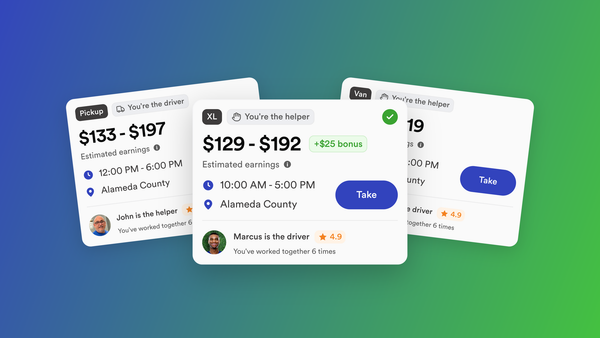
The core difference with Lugg is that the work comes to you. Instead of hunting for loads, you claim a slot — a 4-, 5-, or 8-hour window on the days you want to work — and Lugg dispatches moves to you during that window. You pick which weeks and which slots fit your life, and once you've claimed one, you show up and work it. That's the trade: less freedom to bail mid-window, far less time spent fishing for jobs.
The pay is built differently too. Luggers earn a percentage of the customer fare, and the fare is made up of a base, per-minute labor, and mileage. Drivers take a larger share than helpers because they're providing the vehicle and the equipment. Tips are paid out directly to you. And the payout (slots and tips) is same-day — the money can hit your account the night you work, not several business days later. If you've got a qualifying truck or van and want steadier dispatched work, you can sign up to drive with Lugg in about two minutes, with no membership fee to start; the background check comes after.
"I give Lugg four days a week and my own business two to three days — I'm able to juggle both, which equals a very productive week." — a Lugger in Atlanta
What's the same on both platforms: you're a 1099 independent contractor, you bring your own vehicle and basic moving equipment, and helpers (the second person on a job, who only needs a phone) earn less than drivers. Lugg operates across 4,000+ U.S. cities and 8,000+ ZIP codes.
Can you drive for GoShare and Lugg at the same time?
Technically, yes. Both platforms treat you as a 1099 independent contractor, and neither asks for exclusivity, so some drivers keep both apps active and work whichever has volume on a given day. As long as your vehicle and your moving equipment qualify for both, the only real cost of adding a second platform is the time to get approved — and on Lugg there's no fee to sign up.
The practical move is to treat them as different tools. Use a claimed Lugg slot when you want a block of dispatched, same-day-paid work you can count on, and keep GoShare open for the off-hours commercial loads you'd rather pick off one at a time. Just don't claim a Lugg slot and a GoShare load for the same window — a slot you've claimed is one you show up for.
Which one makes sense for you?
It comes down to whether you'd rather find the work or have it dispatched to you. If you own a box truck or cargo van, you're in a busy metro, and you like the control of accepting individual commercial loads, GoShare can be worth the $49 to try. If you'd rather claim a window, get moves sent to you, and get paid the same day, Lugg's slot model is the better fit.
The work finds you, or you find the work
That's the real choice between GoShare and Lugg — not the pay rate, but who does the work of finding the work. GoShare hands you a marketplace and a weekly payout; Lugg hands you a slot, dispatched moves, and same-day pay. If you've got a qualifying pickup, cargo van, sprinter, or box truck — or just a phone and some open weekends to help — the Lugg sign-up takes about two minutes, and the team typically activates you within the week.