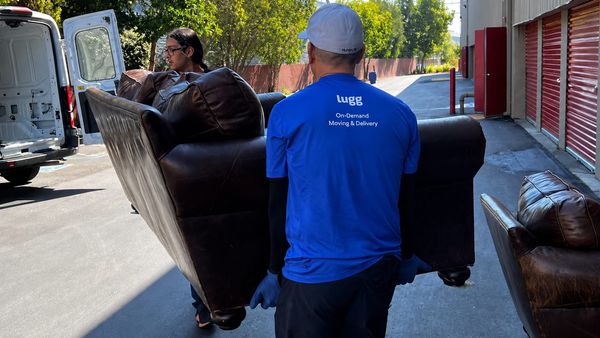


Tip your movers 15% to 20% of the total moving bill, or $20–$60 per mover depending on how long and how hard the job was. Tipping isn't required, but it's customary — moving companies don't fold gratuity into the price, and the crew doing the heavy lifting relies on it. With the average local move running about $1,200, that works out to roughly $180–$240 split across the crew. Here's exactly how much to tip by move size, when to tip more or less, and how to hand it over.
Quick reference: how much to tip movers
| Move type | Time | Tip per mover | Or, % of bill |
|---|---|---|---|
| Single-item or store delivery | Under 1 hour | $5–$10 per mover | 5-10% |
| Half-day move | 4–5 hours | $20–$30 per mover | 15%–20% |
| Full-day move | 8+ hours | $40–$60 per mover | 15%–20% |
| Complex or long-distance move | All day+ | $60+ per mover | Tip toward 20% |
Use these as a starting point, then adjust up for great service or a brutal staircase, and down if something went wrong.
Should you tip movers?
Yes — tipping movers is customary and expected for good service, though it's never mandatory. Moving companies don't include tips in the price of your move, so a tip is the direct way the crew gets rewarded for the work. Movers do one of the most physically demanding service jobs there is, often in heat, rain, or up several flights of stairs, so a tip for a job done well is the norm rather than the exception.
The one rule of thumb worth remembering: tip on the quality of the service, not just the size of the truck. A two-person crew that shows up on time, wraps everything carefully, and never complains earns a tip even on a small job.
How much should you tip movers?
A good baseline is 15% to 20% of your total moving bill, split among the crew — so it helps to know roughly what your move will cost before you settle on a number. Many people find it easier to tip a flat amount per mover based on how long the job took: $20–$30 each for a half-day move, $40–$60 each for a full day, and $60 or more per person for an especially complex or long-distance job.
For a quick single-item pickup or a store delivery that takes under an hour, $5–$10 per mover is a fair, appreciated gesture. The percentage method and the per-mover method usually land in the same range, so use whichever is easier to calculate on moving day.
What to tip movers for 2 hours
For a 2-hour move, plan on roughly $10–$20 per mover, or 15%–20% of the bill if that comes out higher. A short move is still real labor — loading and unloading are the hardest parts regardless of how far you're going — so the per-hour tip rate doesn't drop just because the clock is short. If two movers each worked hard for two hours, $30–$40 total is a solid tip.
Factors that affect how much to tip
Three things should nudge your tip up or down from the baseline.
Difficulty of the move. Heavy or fragile items, narrow hallways, multiple flights of stairs, tight parking, or specialty pieces like a piano or safe all add real effort. A genuinely hard job warrants the higher end of the range, or more.
Quality and professionalism. Were the movers on time, careful with your belongings, and respectful of your floors and walls? A crew that goes above and beyond — solving a problem you didn't expect, protecting a doorframe, staying upbeat — has earned a more generous tip.
Extra services. If the crew packed boxes for you, or disassembled and reassembled furniture, factor that added work into the gratuity.
When it's okay to tip less (or not at all)
Tipping rewards good work, so it's reasonable to reduce or skip a tip when the service falls short. Fair reasons include a poor attitude or unprofessional behavior, belongings damaged through clear negligence, or unnecessary delays and obvious lack of effort. If something broke but the movers were honest, apologetic, and helpful with the claims process, many people still tip a reduced amount — the accident matters less than how the crew handles it.
How to tip your movers
The traditional method is cash handed to the crew lead at the end of the job, who splits it among the team. But digging for exact cash on a chaotic moving day is a hassle, and many on-demand moving services now let you add a tip in the app after the move is complete and split it automatically among the crew. Tipping digitally also gives you a record, which is useful if you're tracking the cost for a business move or reimbursement.
If cash or an in-app tip isn't in the budget, there are still meaningful ways to show thanks: keep cold water or sports drinks on hand, have coffee ready for an early-morning or winter move, and leave a detailed review naming the crew on Google, Trustpilot, or the app store. A public shout-out genuinely helps movers who are rated on their work.
What not to give your movers
Alcohol is never an appropriate tip or gesture, as all reputable moving companies have strict policies against drinking on the job.
While offering snacks can be a kind gesture, it’s best to avoid anything that could trigger allergies (e.g., nuts, dairy, or gluten). When in doubt, sticking to bottled water or sealed, allergy-friendly options is safest.
Reward a move done right
Tipping movers comes down to a simple range: 15%–20% of the bill, or about $20–$60 per mover scaled to how long and how hard the job was. Tip toward the top for a difficult move handled well, ease off if the service disappointed, and remember that a cold drink and a named review go a long way too. However you do it, a tip is the clearest way to thank the people who carried your life up the stairs — and the easiest way to end up with a crew worth tipping is to book professional movers with clear, upfront pricing in the first place.