
If you own a box truck, the question isn't whether there's work — it's whether your specific truck clears the bar, and whether you need a CDL to drive it. Both answers are simpler than the forums make them sound. A box truck qualifies to drive for Lugg if it's a 2001 or newer model in sound cosmetic condition, with at least 12 feet of cargo length, 6 feet of interior width, and 7 feet of interior height. To drive with Lugg, you don't need a commercial license.
Lugg is an on-demand moving platform where box truck drivers pick up local moving and delivery slots in their own truck, with no CDL required, earning $42 to $47 an hour on average plus tips.
That covers most of the trucks people actually own. Here's how the sizes sort out.
Box truck sizes and which Lugg tier they fit
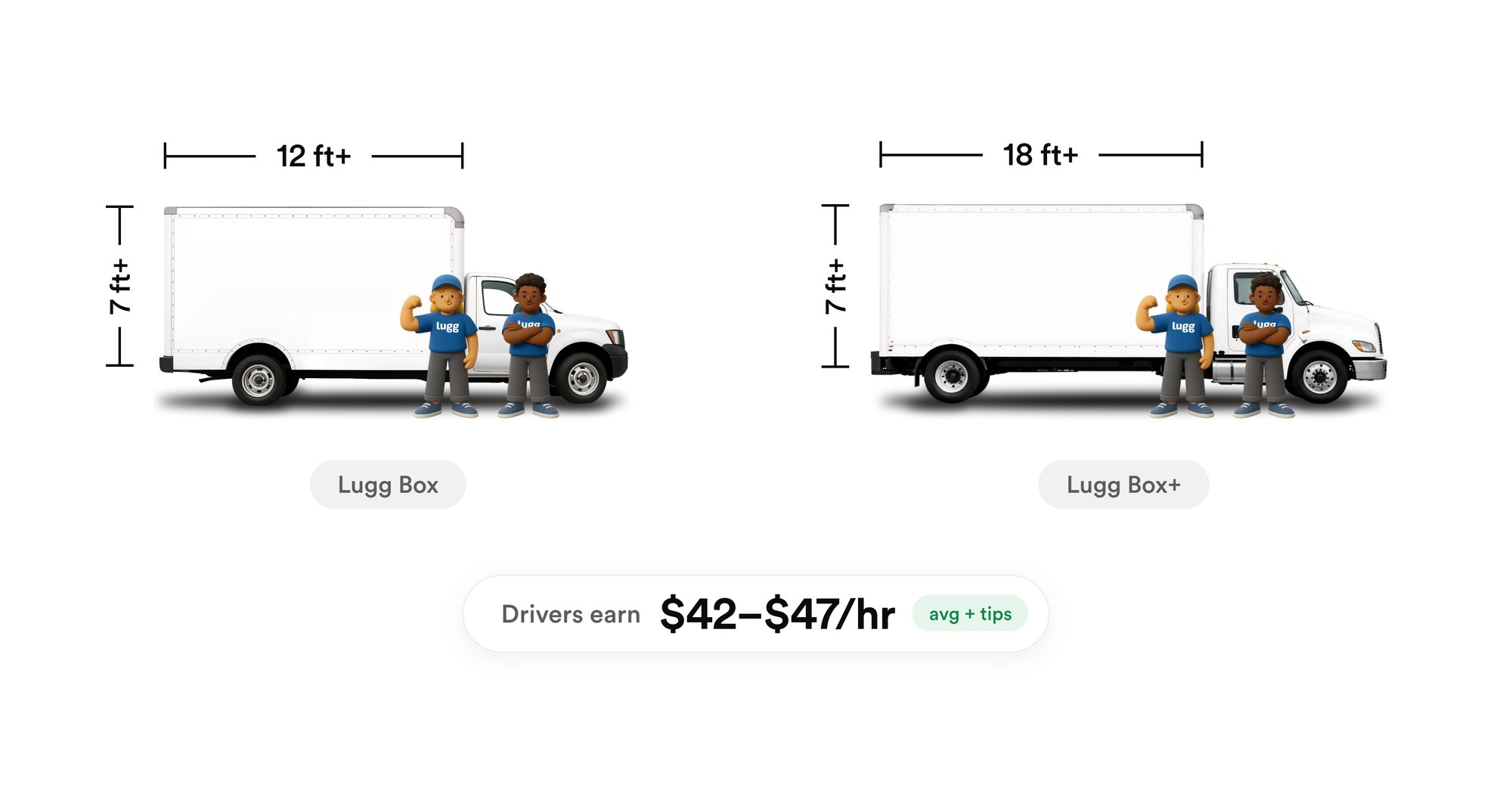
Lugg splits box trucks into two tiers by cargo length. Interior width and height barely move across the range — most boxes run somewhere around 8 feet each way — so length is the number that decides your tier.
| Cargo length | Lugg tier | What it handles | Average pay |
|---|---|---|---|
| Under 12 ft | XL | A 10 ft box usually onboards as an XL driver rather than being turned away | $37/hr |
| 12 ft or longer | Box | Full-home moves and big furniture deliveries | $42/hr |
| 18 ft or longer | Box+ | 3+ bedroom homes, commercial moves, the biggest deliveries | $47/hr |
Those hourly figures are averages rather than starting rates — your base is set by your market, hourly in some and commission in others, and in hourly markets you earn whichever is higher. Working about 20 hours a week puts a box truck driver in the range of $3,650 to $4,050 a month; at 40 hours it's roughly $7,250 to $8,150. Tips sit on top of that, split evenly with your helper and never cut by Lugg, and drivers are separately reimbursed for qualifying zone miles and most required tolls. What a truck can earn across different kinds of work is a wider question than any one platform's rates.
Which box trucks qualify as a Lugg Box?
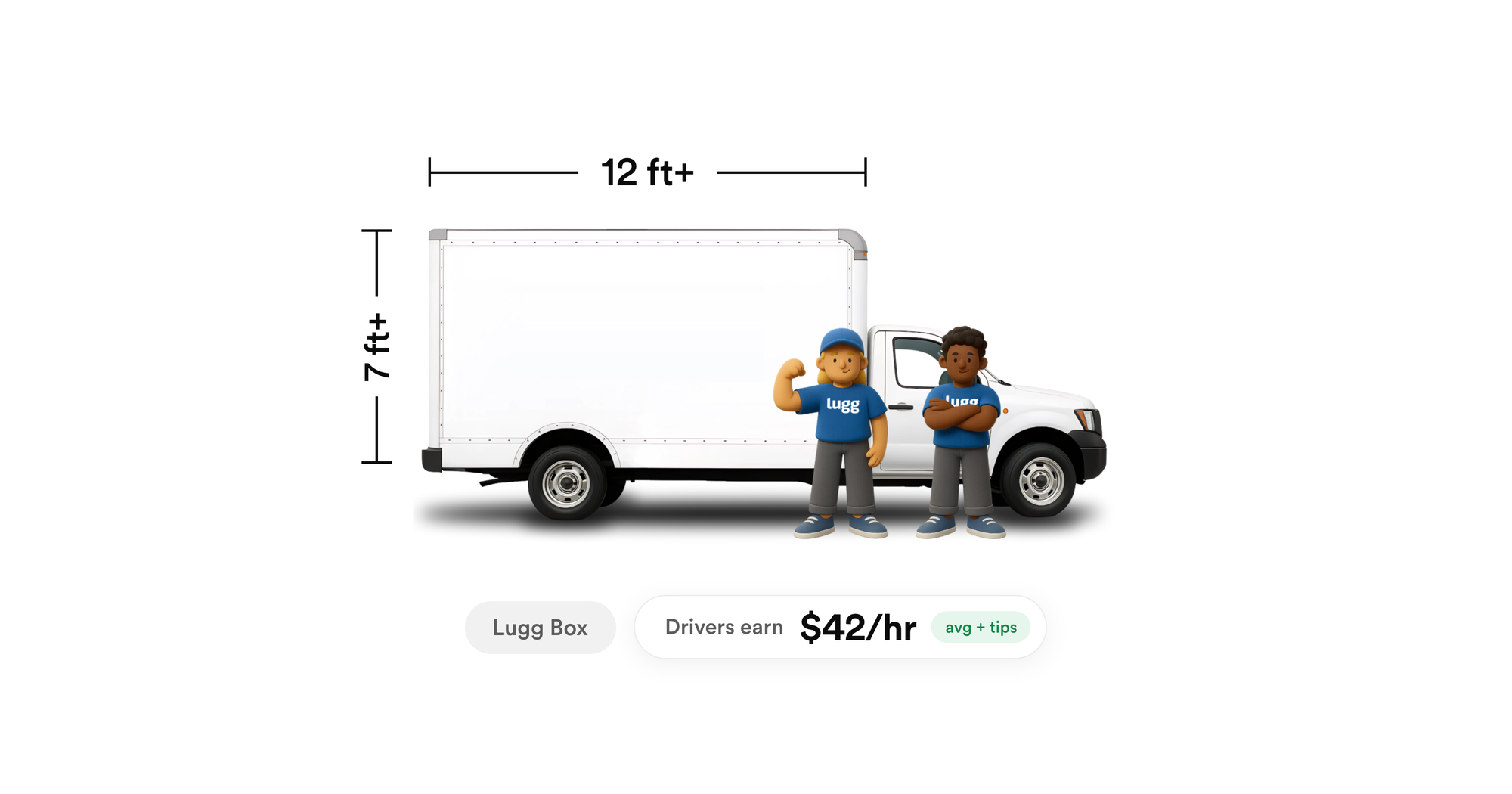
Any box truck with a cargo area at least 12 feet long, 6 feet wide and 7 feet tall, on a 2001 or newer chassis. That's the entry tier, it pays $42 an hour on average, and it's where most owner-operators land — a 12, 14 or 16-footer all clear it comfortably.
What it handles is the bread and butter of the platform: full-home moves for one and two-bedroom places, appliance runs, and the big furniture deliveries that won't fit in anything smaller.
If your box comes in under 12 feet, that's not a rejection. A 10-footer usually onboards as an XL driver instead — the tier directly below, still paying $37 an hour on average — so the truck you already own has somewhere to go either way.
Does a 26-foot box truck qualify to drive for Lugg?
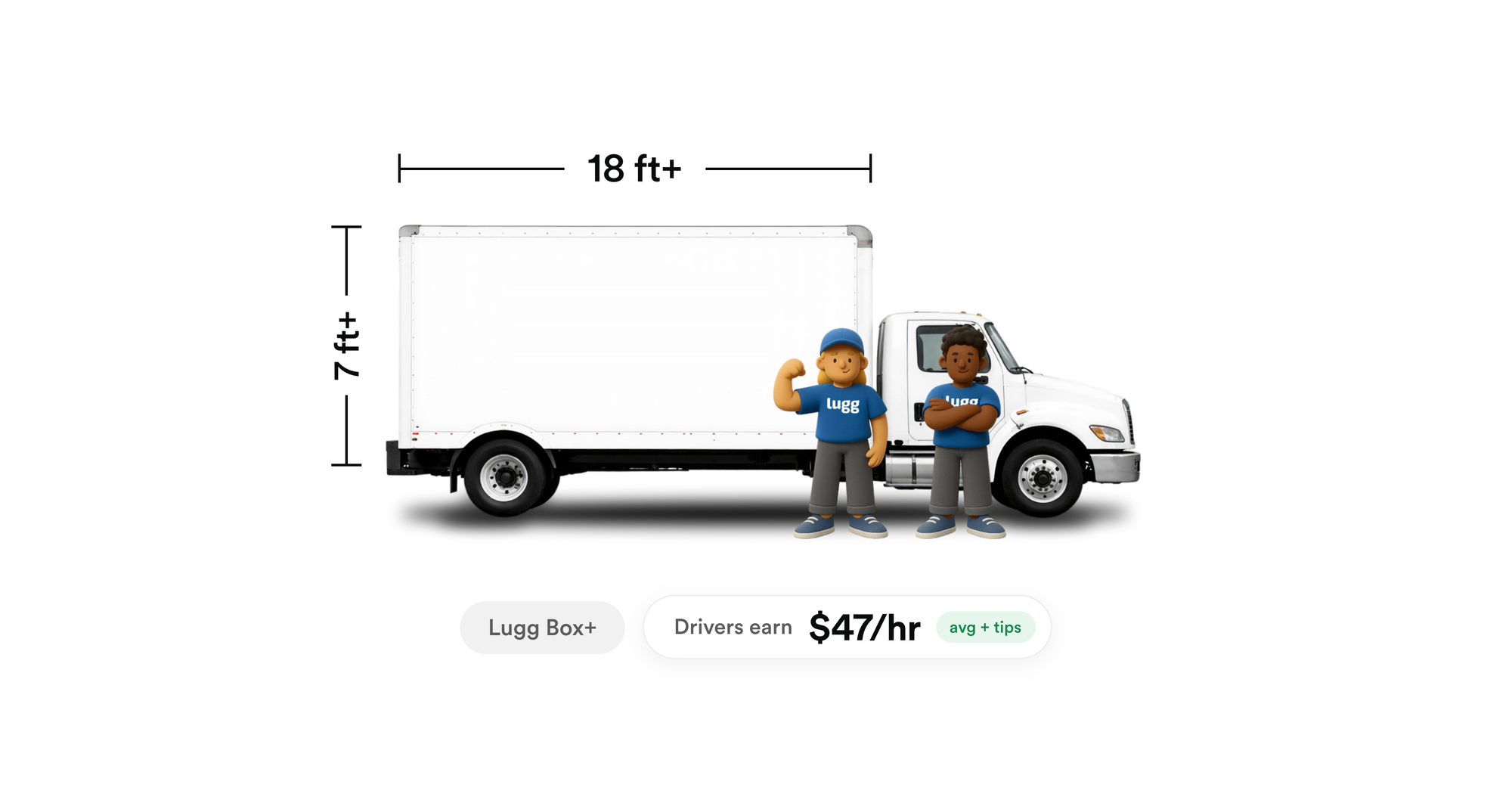
Yes, and it lands in the higher-paying tier. Anything with 18 feet or more of cargo length qualifies as a Box+ at $47 an hour on average, and there's no upper limit — drivers aren't turned away for running longer than 26 feet.
This is worth spelling out because the 26-foot truck is the one people assume is off-limits. It's the standard rental class, it's the biggest thing most drivers will ever own, and it sits just under the weight line that would require a commercial license. On Lugg it's the top tier rather than a problem.
Box+ slots are the 3+ bedroom homes, the commercial moves, and the deliveries too large for a standard box. Fewer of them come up than standard box jobs, but they pay $5 an hour more and the truck qualifies for everything below it too.
What are Lugg's box truck driver requirements?
Six things, and most box truck owners already have all of them:
- The truck: 2001 or newer, sound cosmetic condition, no customizations to the cargo area or exterior decals.
- Cargo dimensions: at least 12 ft long, 6 ft wide, and 7 ft high inside. Those are minimums, not descriptions — a real 16-footer is usually wider and taller than the floor.
- Insurance in your own name, plus proof you either own the truck or are an insured driver on it.
- A valid driver's license, eligibility to work in the US, and you're 21 or older to drive. Moving Helpers, who ride along without a vehicle, can be 18 — worth knowing if you drive but someone in your household wants in too.
- A recent smartphone — iPhone or Android — with a reliable data plan, since the slots and the job itself run through the app.
- A background check, which is required and paid for by the Lugger — the cost comes out of your future earnings rather than as a charge upfront.
- Basic moving equipment you bring yourself — blankets, ratchet straps, a dolly, stretch wrap. A standard box needs about eight blankets, a Box+ closer to fifteen. It's a small one-time cost that tends to pay for itself in a slot or two.
Signing up takes about two minutes, and between the document upload, a few short onboarding videos and the background check, most drivers are picking up their first slot within a few days.
What size box truck can I drive without a CDL?
Any box truck rated at 26,000 pounds GVWR or under, which covers essentially every truck in the sizes above — including the 26-footers people assume are off-limits.
The confusion comes from two different numbers that both land on 26. Length in feet and gross vehicle weight rating in pounds are unrelated, and it's the weight that governs the license. A commercial driver's license is required once a vehicle's GVWR hits 26,001 pounds or more. Most 26-foot box trucks — the standard rental class — are built to sit just under that line precisely so a non-CDL driver can operate them.
GVWR is the maximum the truck is rated to weigh fully loaded, cargo included. It's on the door jamb sticker, not something you calculate. Check that number and you have your answer.
Lugg never asks for a commercial license, on any vehicle — a regular driver's license covers pickups, cargo vans, and box trucks alike. The limit is the law's, not Lugg's: buy a truck rated over 26,000 pounds and the license that comes with it is yours to go and get. If you're thinking further ahead than one truck, the registration and licensing side is covered in the box truck business guide.
What disqualifies a box truck?
Four things, and none of them are about how the truck drives.
Age. Anything older than a 2001 model year is out, regardless of condition or mileage. It's a hard line, not a judgment call.
Cosmetic condition. The truck shows up at a customer's home, so visible damage, heavy rust, or a box that looks rough will hold up activation. Mechanical condition matters for your own sake; cosmetic condition is what's actually assessed.
Modifications. Changes to the cargo area — shelving builds, partitions, anything that reduces or reshapes usable space — disqualify a truck, because the tier system depends on the box measuring what it claims to measure. Exterior customizations count too.
Falling short on any single dimension. The three measurements are a floor, not an average. A 20-foot truck with a low ceiling doesn't qualify on length alone; it has to clear all three.
Worth checking these before you get the tape out, since they rule a truck out fastest and none of them need measuring.
How do you measure a box truck's cargo area?
Measure the inside of the box, not the truck. A 16-foot truck is not 16 feet of usable cargo floor on every model, and the number that matters for qualifying is what's actually inside the walls.
1: Measure length from the back of the cab wall to the inside of the closed door
Run the tape along the floor. Stop at the door itself, not at the end of the ramp or the lip that extends past it. This is the number that sets your tier.
2: Measure width wall to wall, straight across the inside
Measure the full interior width, not the gap between any wheel-well humps. Wall to wall is what counts.
3: Measure height from the floor to the lowest point of the ceiling
If there's a support beam or a light fixture hanging below the roofline, measure to that, since it's what limits what will actually slide in.
4: Check the GVWR sticker on the driver's door jamb
Confirm it reads 26,000 pounds or less. This is your licensing answer, and it takes ten seconds.
Write those four numbers down. They're what the sign-up asks for, and having them ready is the difference between finishing in one sitting and going back out to the driveway.
What can a box truck carry that a cargo van can't?
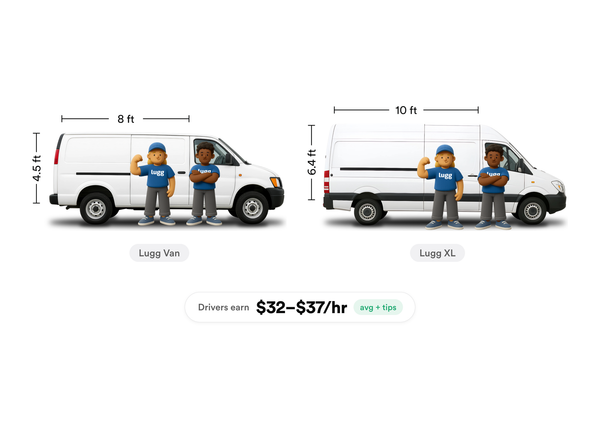
Height and volume, mostly. A cargo van tops out around 4.5 feet of interior height and an XL high-roof van reaches 6.4 feet — enough for a king mattress, not enough to stand a tall armoire upright or stack a full bedroom without playing Tetris. A box gives you roughly 7 feet or more, a flat floor, and square walls.
That changes which slots you can pick up. Whole-home moves, commercial and retail deliveries, multi-room jobs, and the long awkward pieces that don't bend — sectionals, tall shelving, treadmills — route to box trucks. It's why the box tiers pay the most per hour on the platform.
What a box doesn't change is what two people can safely lift. The per-item cap is 125 pounds per Lugger, 250 for a two-person crew, no matter how much room is behind you. A lift gate helps when a truck has one, but they aren't guaranteed on any tier, so don't assume one is coming.
The pickup truck and cargo van tiers have their own qualification rules and their own slots, so a vehicle that doesn't clear the box minimums still has a lane.
Can you drive for Lugg with a rented box truck?
Sometimes. Rentals are allowed in some markets, through specific approved rental partners only — never any rental you happen to find. Which partners and which markets changes, so confirm with the onboarding team before you put money down on a truck you're planning to work in.
Buying used is the more common path, and it's the one that gets weighed against the licensing question above: a truck under 26,000 pounds GVWR keeps you in non-CDL territory and still qualifies for the highest-paying tiers on the platform. There's no advantage in going bigger than that unless you have a reason outside Lugg.
Check your box, then start your sign-up
The whole qualification test is four measurements and a sticker: 12 feet or more of cargo length, 6 feet wide, 7 feet high, and a GVWR at or under 26,000 pounds. If your truck clears that, it qualifies, and the tier it lands in decides what you earn per hour.
From there you sign up, then pick up the slots that fit your week, in your own truck, on your own schedule. Full requirements and current pay for the tier live on the box truck driver page, and if you're still deciding whether to run this full-time or alongside another job, that tradeoff has its own breakdown.